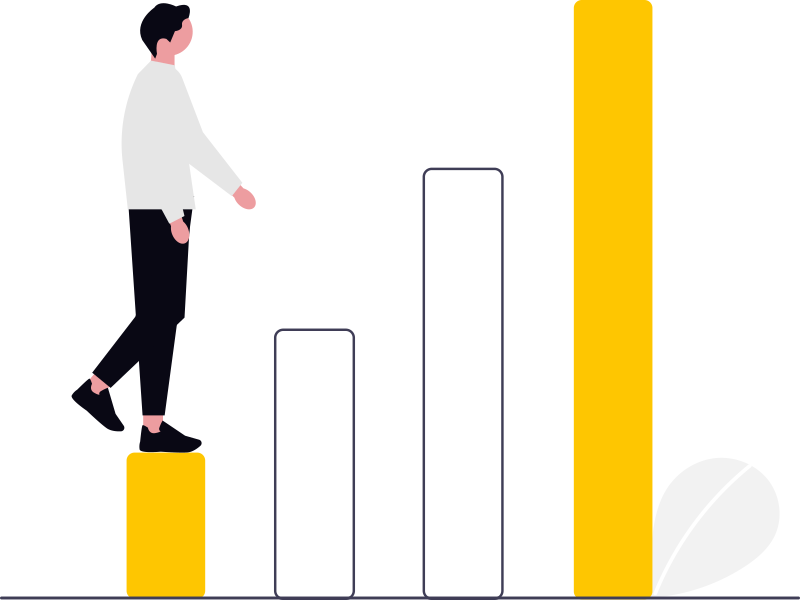
Orientation Toward Change
01How people move toward uncertainty through curiosity, experimentation, initiative, and willingness to engage with evolving systems.
- Curiosity before certainty
- Practical experimentation
- Constructive initiative
Organisations are being pushed toward new ways of working shaped by AI, automation, rapid learning cycles, and uncertainty. Leaders need a clearer model of what effective human capability looks like in that environment.
This framework helps leaders understand the human capabilities that support adaptation, learning, collaboration, and effective work redesign in AI-enabled workplaces.
The goal is not to label people as future fit or not future fit. It is to create better conditions for learning and more thoughtful leadership decisions.
Traditional indicators of performance, such as role tenure, procedural expertise, visibility of effort, or efficiency inside existing systems, may not be enough to identify who will contribute strongly in future ways of working.
We believe organisations cannot reliably evaluate adaptive capability without first giving people meaningful exposure to new ways of working. People need the chance to experiment with AI systems, collaborate in redesigned workflows, and demonstrate responsiveness in practice.
Capability is best understood through practice, not prediction.
Rather than relying only on interviews, assumptions, or static competency models, leaders observe adaptive capability while people are working with new tools and new patterns of problem-solving.
Give people meaningful contact with new AI-enabled ways of working before drawing conclusions about future capability.
Watch how individuals and teams respond to uncertainty, learning demands, redesigned workflows, and collaboration challenges.
Use the evidence to shape coaching, team design, capability development, and more useful leadership conversations.
The domains are interconnected. Together they give leaders a practical lens for noticing how people adapt when the work itself is changing.
How people move toward uncertainty through curiosity, experimentation, initiative, and willingness to engage with evolving systems.
How rapidly people learn, update thinking, adapt behaviour, and evolve professional identity as roles and expectations change.
How people evaluate information, exercise judgment, and rethink workflows, systems, and human-AI interactions in complex environments.
How people collaborate, remain psychologically functional during uncertainty, support others through change, and stay connected to meaningful contribution.
The framework shifts the conversation from static judgement to evidence-informed development.
Response to uncertainty
Who moves toward ambiguity, asks useful questions, and starts testing small next steps?
Learning under pressure
Who updates their thinking when tools, expectations, or evidence change?
Human-AI work redesign
Who can rethink the workflow, not just operate the current process faster?
Social contribution
Who helps others stay functional, connected, and constructively engaged through change?

Behaviour Scientist
Brad specialises in the human side of technology adoption and complex behaviour change challenges. He focuses on understanding cultural and structural barriers and identifying innovative, low effort/cost opportunities to leverage existing motivation.
The outcome is more thoughtful leadership, healthier organisational adaptation, and better-informed decisions about team design, capability development, and recruitment.