

AI tools can now do the hard thinking for you, and the hard thinking is where expertise comes from. Used as a substitute, AI makes people faster but less capable. Used as an amplifier, where you think first and AI helps you go further, it builds capability instead.
Contents
Why this is a new problem
Every new tool comes with a wave of worry, and most of it turns out to be overblown. Spreadsheets didn’t make accountants stupid. Search didn’t end research.
The difference is that those tools left the judgement with you. You designed the spreadsheet model and decided what the numbers meant. You chose which search results to trust.
Today’s AI tools can take the judgement too. Ask one to review your business and it will find the problems, choose the priorities, and write the plan. In 2026 it doesn’t even need much asking: agents can now take a piece of work from the first bit of research to the finished document.
The output reads like thinking. Whether anyone actually thought about it is a separate question, and it’s getting easier to skip.
This is the first kind of tool that can do the hard part for you, and the hard part is where expertise comes from.
What the struggle is for
Expertise is mostly built from doing difficult work badly, then less badly.
- Building a financial model by hand teaches you how the numbers push on each other.
- Writing a hard document shows you what you actually think, often for the first time.
- Working through a messy problem gives you the pattern recognition you’ll lean on next time.
This is tacit knowledge: the stuff you can’t easily explain but that makes you good at your job. Skip the work and you skip the learning.
The feedback loop
The catch is that you need that expertise to judge what the AI gives you.
- An analyst who has never built a model won’t spot the error in a generated one.
- A writer who has never wrestled with structure won’t notice when a draft is fluent but empty.
- A strategist who has never worked a messy problem won’t see what a tidy framework leaves out.
The more we hand over, the less able we are to check what comes back. Early research points the same way. A 2025 Microsoft Research and Carnegie Mellon survey of 319 knowledge workers found that the more confident people were in AI, the less critical thinking they reported applying. An MIT Media Lab study the same year found that people who wrote essays with ChatGPT struggled to quote their own work minutes later, and felt less ownership of it. Both studies are early and fairly small, so treat them as warning signs rather than proof.
The good news
So the real question is how to use AI, because used well it helps a lot.
These tools can take the routine work off your plate so you can spend more time on the parts that need a human, like judgement calls and the hard problems. Analysts can ask better questions instead of formatting reports. Engineers can spend their time on design instead of boilerplate.
There’s one condition. You can’t skip the climb. The people getting the most out of AI right now built their expertise before it arrived, so they have something to amplify. For people starting their careers with AI from day one, organisations have to deliberately protect the work that builds judgement.
Four ways to use AI
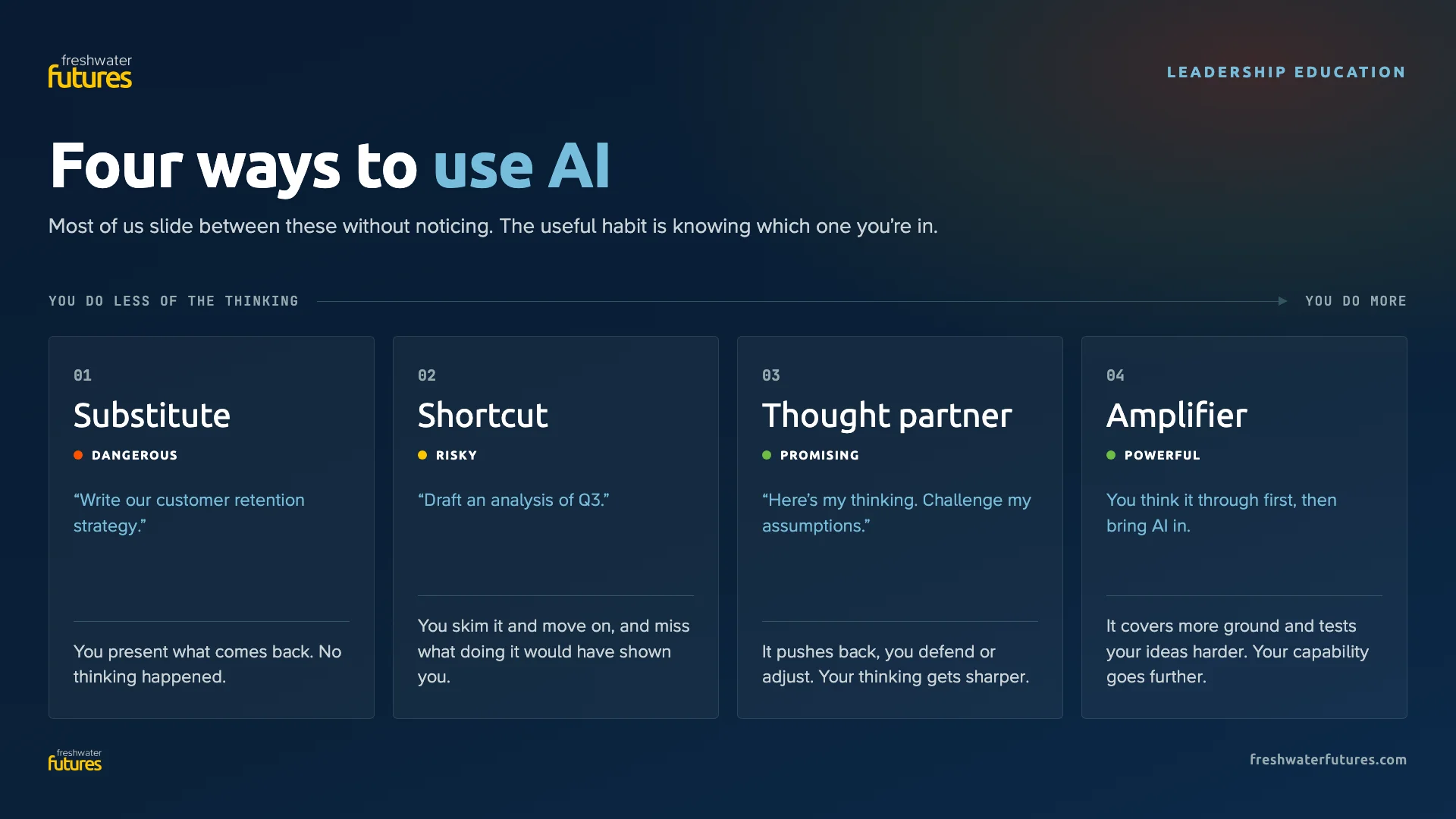
🔴 Substitute. “Write our customer retention strategy.” You present what comes back. No thinking happened.
🟡 Shortcut. “Draft an analysis of Q3.” You skim it and move on. You miss what you’d have found by doing it.
🟢 Thought partner. “Here’s my thinking on our priorities. Challenge my assumptions.” It pushes back, you defend or adjust. Your thinking gets sharper.
🟢 Amplifier. You do the thinking first, then use AI to cover more ground and test your ideas harder. Your capability goes further.
Most people slide between these without noticing. The useful habit is noticing which one you’re in.
What amplifying looks like
Take a strategic plan.
- Use AI to research. Let it run the deep research: market data, competitor moves, precedents. Then review it yourself and treat it as input.
- Do the thinking yourself. Work out the options and argue the trade-offs with your team. Rough notes are fine.
- Use AI to challenge it. Ask it to find the holes, argue the opposite case, and generate scenarios you didn’t consider.
- Use AI to write it up, then read it critically. Does it say what you actually think? What did it smooth over?
The result has the same depth of thinking, built in less time, and you can defend every line because the reasoning is yours.
The same pattern holds elsewhere. A financial analyst still builds the base model, then has AI run ten scenarios instead of three. An engineer still owns the architecture, then lets an agent write and test the routine code.
What organisations can do
Rolling out AI to make people faster is too narrow a goal. A few questions worth working through:
- What work must our people keep doing to stay good at their jobs?
- Where do we want deliberate friction, so a human has to think before something goes out?
- How will new starters build judgement if the foundational work is automated?
One rule is worth adopting early: AI informs, people decide. No major strategic, financial, or people decision should rest on AI output alone. Someone should be able to explain the reasoning and stand behind it.
Questions worth asking
- Are we using AI to think better, or to avoid thinking?
- Can we still tell good work from fluent work?
- When did our team last work through a hard problem from scratch?
- If the tools went down for a week, what would we struggle to do?
The choice
These tools are good and getting better. Whether they make us better at our jobs, or just faster at producing things, depends on how we use them.
The amplifier path is harder. It means keeping up the foundational work when a shortcut is right there, and designing teams that build expertise on purpose. It’s also the only path where people end up more capable than they started.
That choice gets made in small moments, every time we decide whether to think something through or hand it over.
Frequently Asked Questions
- It can, if AI does the thinking for you. Expertise comes from doing hard work yourself, and early research links heavy reliance on AI with less critical thinking. Used as a thought partner or amplifier, AI can make you more capable instead.
- As a substitute, AI does the thinking and you pass on what it produces. As an amplifier, you do the thinking first, then use AI to research more widely, challenge your ideas, and write things up faster. The reasoning stays yours.
- Carefully. They still need to do enough of the foundational work, like building models and writing hard documents, to develop judgement. Organisations should decide which work stays manual for new starters, rather than leaving it to chance.
- Decide which work your people must keep doing, add deliberate friction before important decisions, and adopt a simple rule: AI informs, people decide. Someone should always be able to explain and defend the reasoning.
- Yes, though it is early. A 2025 Microsoft Research and Carnegie Mellon survey linked confidence in AI with less critical thinking, and a 2025 MIT Media Lab study found people who wrote with ChatGPT remembered less of their own work. Both are small, so treat them as warning signs.
Get Started
We'll help you build it.
About Freshwater Futures
We help teams build AI capability that holds up, through AI training and Vibe-a-thons where people work on their own real problems. The aim is for your team to get faster and more capable at the same time.
If you want to talk through how your team is using AI today, get in touch.


